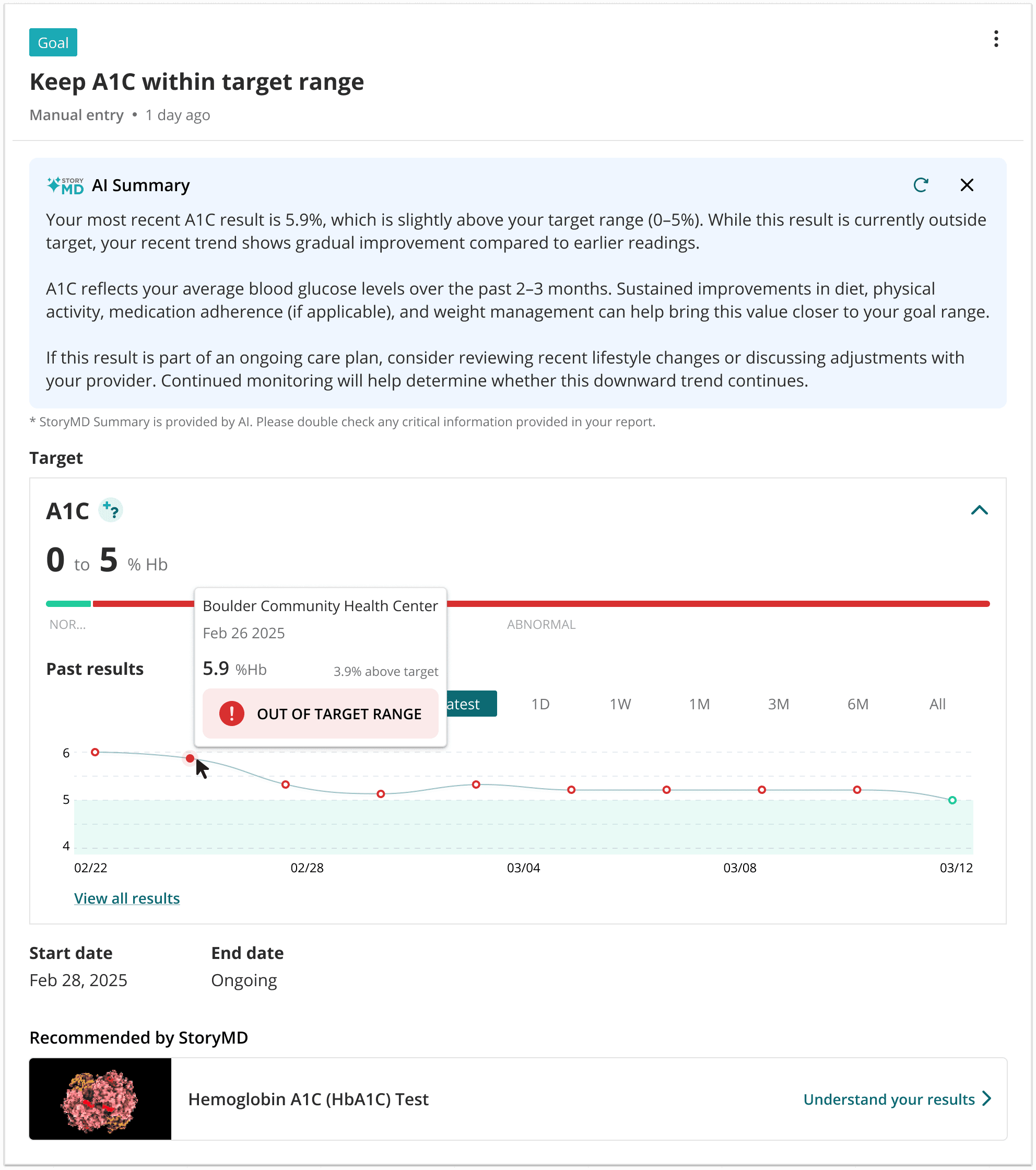
Introduced context-aware trend detection, adaptive risk flagging, and AI-generated summaries to transform raw health data into actionable insight for both patients and providers.
Project scope
Role
UX Lead
Timeline
2024-5
Team
Design, Engineering, ML contractor, CTO
Status
Partially shipped
Context
StoryMD’s PHR allowed users to aggregate lab results, wearable metrics, and clinical records. However, raw data alone did not provide clarity. Users were required to interpret numeric results, reference ranges, and trends without contextual guidance.
Providers reviewing patient data faced similar cognitive overload — scanning multiple data types without prioritization or synthesis.
Problems
Raw biomarker data lacks immediate meaning
Static reference ranges fail to account for demographic variation
Trend identification requires manual scanning
AI summaries risk over-automation or misinterpretation
Patient and provider workflows require different levels of detail due to different contextual awareness
Designing for clarity without over-automation
Surface what matters
AI was used to identify and prioritize up to 10 significant trends rather than summarizing every data point.
Preserve clinical integrity
Reference ranges remained visible, with AI acting as assistive interpretation — not authoritative diagnosis.
Differentiate workflows
Patient-facing summaries emphasized clarity and reassurance. Provider-facing views emphasized precision and data traceability.
AI-augmented trend highlighting
We introduced dynamic trend detection within the “My Trends” view, allowing the system to surface meaningful patterns across time rather than requiring manual chart scanning.
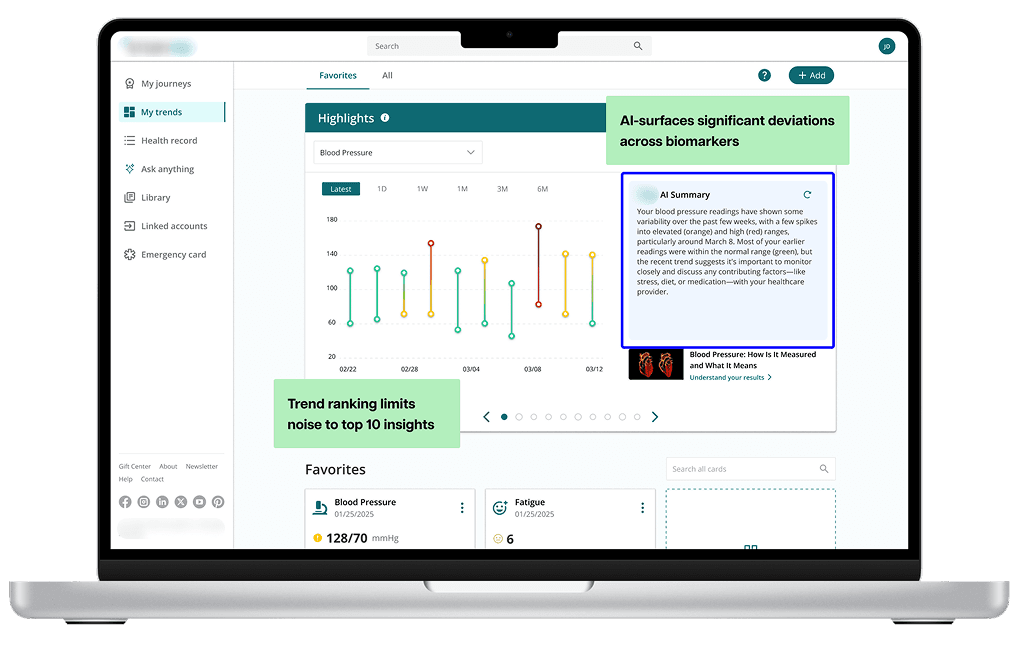
My trends with AI-selected highlights
Adaptive risk flagging
Risk flags were generated using coded reference ranges aligned to standardized medical libraries. Where applicable, thresholds adapted based on demographic inputs such as age or sex — ensuring context-aware interpretation.
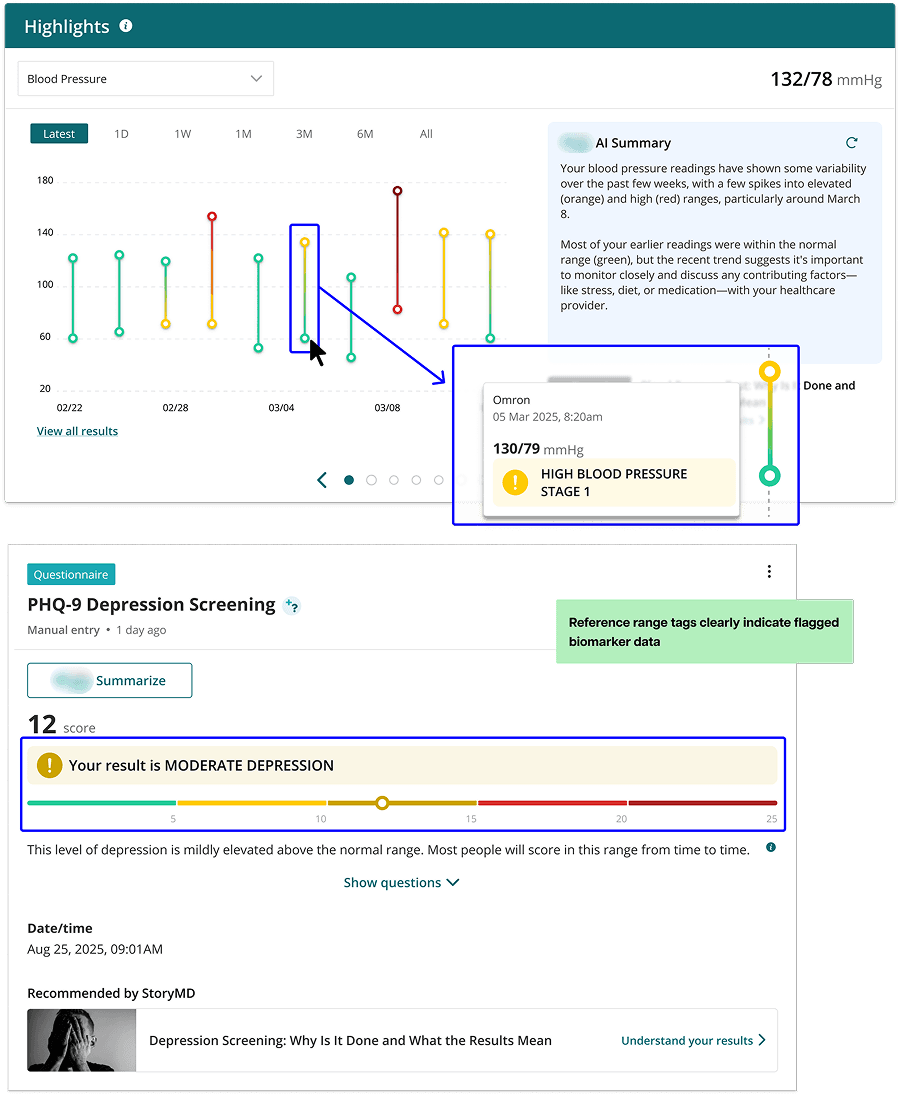
Colour-coded reference ranges for clear flagging of biomarker data
Contextual summaries on demand
Users could generate AI summaries for individual test results. Summaries referenced structured health content from the library and, where relevant, connected to trends within the PHR.
AI summaries for any biomarker data
Implementation status
This is an ongoing project.
Live
AI-generated test result summaries
AI trend highlighting in My Trends
Dynamic reference range visualization
In progress
Expanded adaptive threshold logic
Deeper provider-facing integration
Outcomes
Reduced cognitive load in interpreting lab results
Increased clarity through contextual linking
Introduced scalable threshold logic framework
Established AI interaction standards for the platform
Reflection
This initiative required balancing emerging AI capabilities with clinical responsibility. By positioning AI as assistive rather than authoritative, we improved clarity while preserving trust and domain integrity.